Peter Rollins’ Insurrection: To Believe is Human; To Doubt, Divine. In Chapter Four, “I Don’t Have to Believe; My Pastor Does That for Me,” Rollins observes the ways in which church leaders often ‘believe on behalf of the community,’ ostensibly freeing the community to doubt and disbelieve but actually serving to shelter the community from what he calls the true ‘trauma of the Crucifixion’ (Insurrection, 65) – the loss of ‘all the supports that would protect us from a direct confrontation with the world and with ourselves’ (110). This means that, when a pastor confesses doubts and disbelief, a crisis often ensues; ‘Not because the congregation now doubts, but because the pastor’s belief provided a protective psychological dam that held back their doubt’ (66).
Wednesday, 16 July 2014

Tuesday, 15 July 2014
Excerpt from The Monthly re the carbon tax
Let’s be clear: this is the single biggest reason power prices have skyrocketed. According to the federal treasury, 51% of your electricity bill goes towards “network charges”. The carbon tax, despite relentless propaganda to the contrary, is small beer, comprising just 9%. The rest of your bill is carved up between those companies that actually generate your electricity (20%) and the retailers who package it up and sell it to you (20%). The Renewable Energy Target is such a small cost impost, the treasury’s analysis doesn’t even include it; the Australian Energy Market Commission says it makes up around 5%.
Thanks to the networks’ infrastructure binge, we now pay some of the highest prices in the developed world. The impact has been felt most keenly in New South Wales and Queensland, where the networks are government owned and network charges have accounted for two thirds of the price increases.
For a Coalition intent on destroying the carbon tax, the price hikes have been a gift – “proof” that the carbon tax is as ruinous as they predicted. Chris Dunstan, from the Institute for Sustainable Futures, thinks that what the networks have done over the past five years may actually be the secret to Tony Abbott’s success. “If electricity prices hadn’t doubled,” he says, “the carbon tax would not have been anything like the issue it was.”
Thanks to the networks’ infrastructure binge, we now pay some of the highest prices in the developed world. The impact has been felt most keenly in New South Wales and Queensland, where the networks are government owned and network charges have accounted for two thirds of the price increases.
For a Coalition intent on destroying the carbon tax, the price hikes have been a gift – “proof” that the carbon tax is as ruinous as they predicted. Chris Dunstan, from the Institute for Sustainable Futures, thinks that what the networks have done over the past five years may actually be the secret to Tony Abbott’s success. “If electricity prices hadn’t doubled,” he says, “the carbon tax would not have been anything like the issue it was.”
Saturday, 12 July 2014
Were Tony Abbott to praise Indigenous fighting skill, what would it mean?
When Tony Abbott praised the skill and honour of Japanese soldiers, he was licensing Japan's domestic politics. That's why he won't say the same about the frontier wars
 Email
Email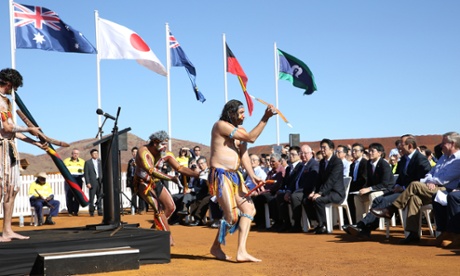
"The past is never dead. It’s not even past."
William Faulkner’s words came to mind when Tony Abbott admired the "skill and the sense of honour that [Japanese soldiers] brought to their task" during the second world war.
In the abstract, Abbott’s comments might sound innocent but, of course, they were uttered, as the prime minister understands quite well, in a particular context.
For Japan’s rightwing, the second world war still matters immensely. Japanese nationalists – such as Shinzo Abe, the current prime minister – have made the nation’s military history a cause célèbre, part of a campaign to reshape the nation today.
Abe has, for instance, visited the graves of executed war criminals, denied that Japan maintained a puppet state in Manchuria, and belittled the army’s sexual slaves, the so-called comfort women.
If Japan’s past can be rehabilitated, it’s much easier to argue for a militarised future – and so revisionism about the crimes of imperial Japan has gone hand in hand with the reinterpretation of Japan’s "pacifist" constitution, so as to allow Japanese troops to participate in military actions abroad.
That’s why the Chinese media responded so angrily to Abbott’s remarks. But there’s another, less obvious, question raised by Abbott’s praise of Japanese military prowess, one relating to domestic rather than international politics.
How is it that a prime minister can praise Japanese soldiers when the skill and honour of those Indigenous people who resisted white settlement receive no official acknowledgement at all?
In his book Forgotten War, Henry Reynolds notes the clear consensus among military historians: the frontier conflicts between colonists and Indigenous Australians – during which tens of thousands died – constituted a war.
John Connor from the Australian Defence Force Academy says bluntly there can be no doubt "that from the 1790s to the 1920, Australian Aborigines fought British soldiers, police and British-born and Australian-born settlers for the control of the continent".
Yet that war – one of the most profound events in the nation’s history – remains entirely uncommemorated. By contrast, we venerate wars of little, if any, national significance.
In 1885, amidst a wave of jingoism, the NSW government hastily sent 700 men to assist the British cause in Sudan – a bizarre and blundering adventure in which the troops made no real military contribution and probably never even fired a shot in anger. Nevertheless, the Australian War Memorial records on its wall the names of casualties suffered in the expedition, all of whom succumbed to disease rather than enemy action.
During the 1880s, more than 2,000 people were killed in Australia by frontier clashes between settlers and Aborigines. As it happens, the conflict probably reached its crescendo at the same time as the Sudan crisis.
"Australians were engaged in two wars during 1885," Reynolds says. "One was serious and deadly. The other was neither. One was fought in Australia, the other on the far side of the world. The fact that the nation commemorates one while ignoring the other is an anomalous situation that demands explanation."
Tony Abbott’s comments hint at what that explanation might be.
Japan boasts one of the largest militaries in the world, and the US has long wanted it deployed to various security operations. That’s why Secretary of Defense Chuck Hagel called the reinterpretation of the "peace constitution" "an important step for Japan as it seeks to make a greater contribution to regional and global peace and security".
Australia, inevitably, agrees. Hence Abbott’s remarks.
Equally, a recognition of Indigenous resistance has obvious implications. Last week, Tony Abbott explained that the nation was "unsettled" or "scarcely settled" before the British arrived.
If you accept that, it’s a lot easier to minimise the government’s responsibilities to Indigenous people, and to downplay their rights over (say) valuable mining leases.
Alternatively, if Abbott were to acknowledge that Indigenous Australians fought with skill and with honour, before being militarily defeated by white colonists, they would be given an agency denied them by traditional histories. Such a statement would also highlight the violence inherent in the settlement project, naturally raising questions about land rights.
These are debates about the past but the issues they raise are not dead. On the contrary, they’re vital for shaping our future.
Thursday, 10 July 2014
OK - I got the message
I've been told not to put news items of interest, to me, on Facebook. So I might begin to put items of interest to me in this place.
Saturday, 21 June 2014
Charity
The genuinely charitable person gives generously from a sense that they too stand in need of charity. Not right now, not over this, but in some other area. They know that self-righteousness is merely the result of a faulty memory, an inability to hold in mind – at moments when one is totally right – how often one has been deeply and definitively in the wrong.
Charity remembers how there might still be goodness amidst a lot of evil. Charity keeps in mind that if someone is tired and stressed, they are liable to behave appallingly. Charity is aware that when someone shouts an insult they are not usually revealing the secret truth about their feelings. They are trying to wound the other because they feel they have been hurt – usually by someone else, whom they don’t have the authority to injure back.
Charity is interested in mitigating circumstances; in bits of the truth that can cast a less catastrophic light on our follies.
In financial matters, charity tends always to flow in one direction. The philanthropist may be very generous, but usually they stay rich; they are habitually the giver rather than the recipient. But in life as a whole, and especially in relationships, charity is unlikely ever to end up being one-sided: who is weak and who is powerful changes rapidly and frequently. You are likely to be, as it were, a patron in one area and a beggar in another. So we must be kind not only because we are touched by the suffering of others but because we properly understand that we too will soon be in urgent need of an equally vital dose of charity in some other part of life.
Friday, 20 June 2014
Growing social inequality in Australia
Growing social inequality in Australia
By Richard Phillips
20 June 2014
The gap between rich and poor in Australia is widening, according to Oxfam Australia research released this week. The Oxfam data punctures Australian Treasurer Joe Hockey’s claims last week at the right-wing Sydney Institute that those pointing to growing social inequality were “misguided” (see: “Australian treasurer defends austerity budget as ‘fair’”).
Entitled Still the Lucky Country? the Oxfam report reveals that the richest 1 percent owns the same wealth as the bottom 60 percent of the population. It also shows that the country’s nine richest individuals have a combined net worth of $58.6 billion, which is more than the combined wealth of the bottom 20 percent, or 4.5 million people. Australia’s wealthiest individual owns more than the bottom 10 percent, or about 2 million people.
“Income inequality in Australia has been on the rise since the mid-1990s,” Oxfam states. “In 1995, Australia had an average level in inequality compared to other wealthy OECD member countries. Today, we are below average, having become less equal than our peers despite having a better performing economy than most.”
The report includes a survey indicating that 79 percent of those polled believe that the gap between the richest and poorest Australians widened over the past decade, with over 60 percent believing that this made Australia “a worse place to live.”
The Oxfam poll also found that 76 percent thought the very wealthy did not pay enough tax; 75 percent wanted the government to take action to close the gap between the rich and poor; and 79 percent believed that the rich had “too much influence.”
The Oxfam report is backed up by a document released last week by Australia21, a non-profit research company, in collaboration with the Australia Institute. Entitled Advance Australia Fair? What to do about growing inequality in Australia, the document states: “In recent decades, the income share of the top 1 percent has doubled, the wealth share of the top 0.001 percent has more than tripled, and the share of the top 0.0001 (the richest one-millionth) has quintupled.”
On the other end of the scale, the bottom 20 percent of people relied on government payments for three-quarters of their income, with more than 35 percent of those on welfare living below the poverty line. Australia’s Newstart unemployment benefit is the lowest of all the OECD countries. Currently over 570,000 children in Australia—or one in six—are living in poverty.
Government tax cuts have disproportionally favoured the wealthy, the report notes, with $71 billion in savings for the top 10 percent of income earners in the past seven years.
As the report states: “The top tax rates have been reduced from 60 cents in the dollar in 1983–84 to 45 cents in the dollar today. Personal income can be disguised as company or superannuation income where it is taxed at only 30 and 15 (or zero) percent respectively.”
Advance Australia Fair ? shows that superannuation tax concessions, which largely benefit the wealthy, cost the government about $35 billion a year and will soon overtake the annual budget for the aged pension and its 2.4 million recipients.
The report also highlights the debilitating impact of social inequality on the health, education and well-being of the poorest sections of society.
“Greater income inequality,” it states, “leads to more unequal access to quality housing, education, nutritious food, and healthcare. Low income groups are less likely to be able to afford to live in neighborhoods that are conducive to better physical and mental health … They are more likely to hold jobs that are precarious and low paid, thereby creating a greater risk of cardiovascular disease and mental ill health.”
Figures cited showed “a consistent correlation between low level of income and high level of heart disease, cancer, diabetes and depression.”
Treasurer Hockey told the Sydney Institute last week that the government faced a budget emergency because too many people were receiving welfare. Contrary to this claim, Household, Income and Labour Dynamics in Australia (HILDA) data released this week by the Melbourne Institute shows that working-age Australians are less reliant on welfare than they were a decade ago.
The HILDA survey, which has tracked a sample of households since 2001, indicated that those relying on welfare aged between 18 and 64 declined from 23 percent of people in 2001 to 18.6 percent in 2011. Those deriving half their income from welfare dropped from 12 to 10.1 percent during the same period.
In HILDA’s sample there was a sharp decline in those reliant on single-parent payments, from 43.8 percent in 2001 down to 32.6 percent in 2011. Fewer were also dependent on the age pension, with the proportion of income coming from the pension declining from 67.8 percent in 2001 to 59.9 percent in 2011.
HILDA report editor, Associate Professor Roger Wilkins, told ABC News’ “Breakfast” on Monday that welfare reliance had been declining for about two decades. “It is hard to reconcile that trend with the current public discourse, particularly coming from the Coalition government. You certainly couldn’t argue that there is a welfare emergency or welfare dependency emergency that’s recently emerged,” he said.
The basic political question facing the working class is not whether more or less people are dependent on welfare or pensions payments, but that adequate social welfare should be provided to all those who require it as a basic democratic right.
The fact that declining numbers of people are reliant on welfare and pensions, under conditions of growing social inequality, increasing poverty and widespread job destruction, is an indictment of successive Labor and Liberal-National governments. During the past decade, in line with the demands of big business, governments have introduced welfare cutbacks and measures that are condemning millions to a life of poverty.
The author also recommends:
The Australian budget and the fight for social equality[11 June 2014]
Monday, 12 May 2014
A sort of ending
We are just about ready to leave for Gaynor's last radiotherapy session. Nearly 10 months since diagnosis. The journey - discovery, diagnosis, chemotherapy, surgery, radiotherapy. One hell of a journey for Gaynor. Now, what might the future hold?
Subscribe to:
Posts (Atom)